By Effective Eco
Solar energy has become an increasingly popular option for homeowners and businesses looking to generate electricity from a renewable source. With rising interest in energy efficiency, lower electricity bills and sustainable living, installing solar panels is an important investment for many UK property owners.
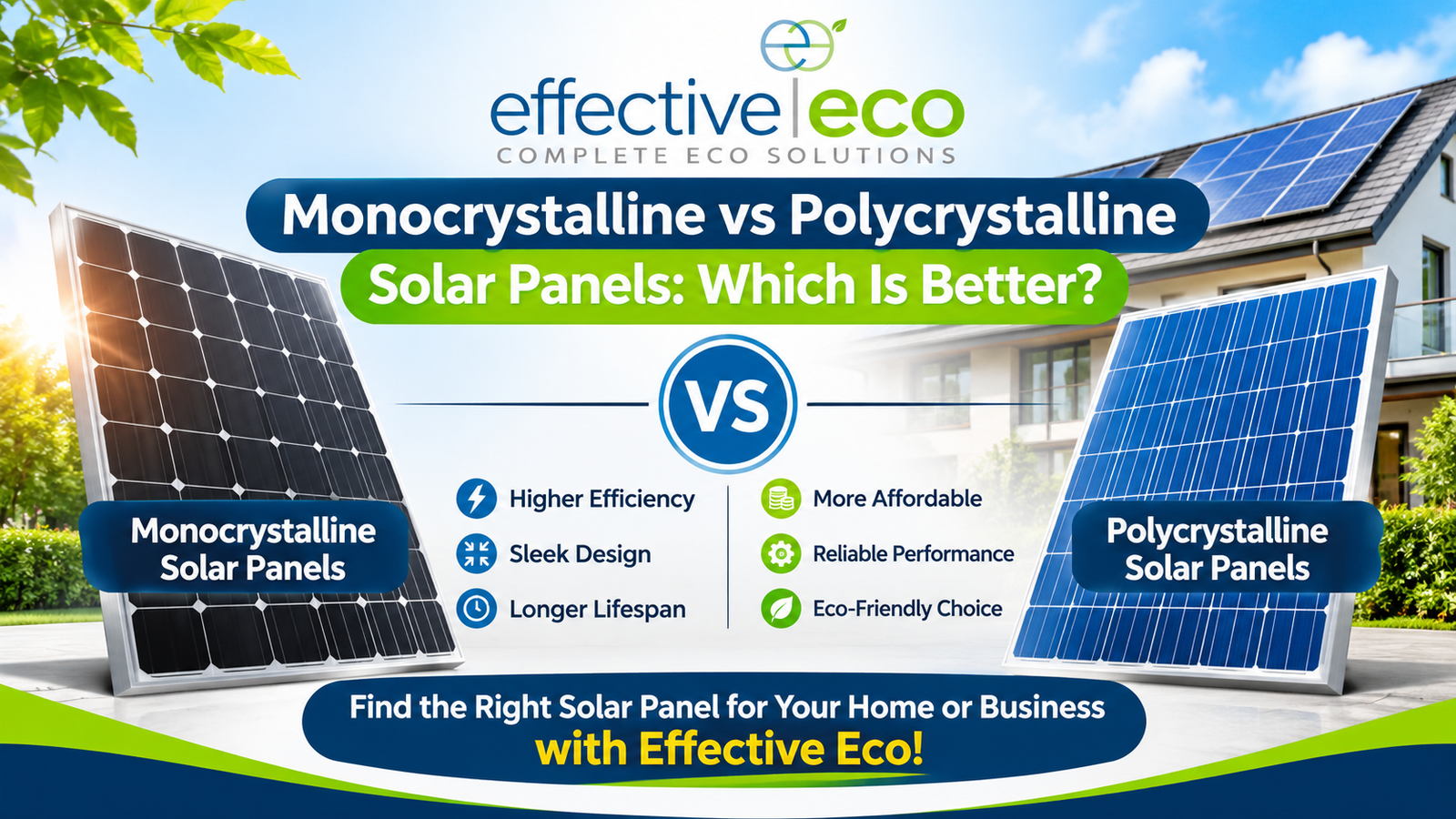
However, choosing the right solar technology can be confusing, particularly when comparing monocrystalline vs polycrystalline solar panels. Both technologies use silicon to convert sunlight into electricity, but they differ in their manufacturing processes, efficiency, appearance, cost and overall performance.
Understanding these differences can help you select a solar photovoltaic (PV) system that matches your electricity requirements, available roof space and investment budget.
Monocrystalline panels are generally preferred for modern residential and commercial installations because of their higher efficiency and better use of limited roof space. Polycrystalline panels can still be suitable in certain circumstances, particularly where upfront equipment cost and available installation space are important considerations.
In this article, Effective Eco explains how both technologies work, their advantages and disadvantages, and the factors you should consider before purchasing or installing a solar energy system.
What Are Monocrystalline Solar Panels?
Monocrystalline solar panels are photovoltaic modules manufactured using silicon wafers made from a single, continuous crystal structure. This manufacturing approach produces highly organised silicon cells that allow electrical charges to move efficiently when sunlight reaches the panel.
These panels are widely recognised by their dark black or nearly black appearance. Their uniform colour and modern design make them a popular choice for residential rooftops and commercial buildings.
Monocrystalline technology has become particularly important in the solar industry because manufacturers can produce high-efficiency modules capable of generating substantial electricity from a relatively small installation area.
How Do Monocrystalline Solar Panels Work?
Monocrystalline panels generate electricity through the photovoltaic effect.
When sunlight reaches the solar cells, photons transfer energy to electrons within the silicon material. This movement creates an electrical current that can be collected and converted into usable electricity.
A typical solar PV system includes several connected components:
- Solar cells: Capture sunlight and generate direct current (DC) electricity.
- Solar modules: Combine multiple photovoltaic cells into a complete panel.
- Solar inverter: Converts DC electricity into alternating current (AC) for household or commercial use.
- Mounting equipment: Secures panels to the roof or another suitable structure.
- Electrical protection: Helps maintain safe operation of the solar installation.
- Solar battery storage: Stores surplus electricity for later use when a compatible battery is installed.
The electricity produced can power appliances, lighting, heating controls and other electrical equipment, depending on the system design.
Advantages of Monocrystalline Solar Panels
Monocrystalline technology offers several benefits for modern solar installations.
1. Higher Conversion Efficiency
One of the main advantages is its ability to convert a larger proportion of available sunlight into electricity compared with conventional polycrystalline modules of similar size.
This is particularly useful when roof space is restricted and property owners want to generate more electricity from fewer panels.
2. Better Use of Available Roof Space
Because these modules generally offer higher power output per square metre, they can help homeowners achieve their electricity generation targets without covering their entire roof.
3. Modern Appearance
Their dark finish and consistent cell design create a clean appearance that works well with many residential properties.
4. Strong Long-Term Performance
Quality monocrystalline panels are designed for long-term outdoor operation. They typically come with product and performance warranties, although the exact terms depend on the manufacturer.
5. Suitable for Residential and Commercial Applications
These panels can be used in homes, offices, warehouses, factories and other properties where efficient electricity generation is required.
Disadvantages of Monocrystalline Solar Panels
Despite their benefits, monocrystalline panels have some limitations.
- Their purchase price can be higher than comparable lower-efficiency alternatives.
- Manufacturing requires carefully controlled silicon crystal production.
- Performance still decreases when solar cells become hot.
- Shading, incorrect positioning and poor system design can reduce electricity generation.
- Higher panel efficiency does not automatically guarantee the best financial return.
For these reasons, customers should compare complete solar system proposals instead of choosing panels based on efficiency alone.
What Are Polycrystalline Solar Panels?
Polycrystalline solar panels, also called multicrystalline solar panels, are photovoltaic modules manufactured using silicon containing multiple crystal structures.
Unlike monocrystalline technology, the silicon material is melted and formed into blocks containing numerous silicon crystals. These blocks are then cut into wafers and processed into solar cells.
The resulting panels usually have a blue or blue-speckled appearance because of their different crystal structures and light-reflection characteristics.
Polycrystalline modules were historically popular because their manufacturing process was less demanding and could offer a lower purchase price than monocrystalline alternatives.
Although they are less common in today’s high-efficiency solar market, understanding this technology remains useful when comparing older solar installations and available equipment.
How Do Polycrystalline Solar Panels Work?
Polycrystalline panels also use the photovoltaic effect to produce electricity.
When sunlight reaches their silicon cells, energy from the light activates electrons and creates an electrical current. The current is collected through electrical contacts and transferred through the solar PV system.
Their operating principle is fundamentally similar to that of monocrystalline panels. The main difference is the internal crystal structure of the silicon material.
Multiple crystal boundaries can affect how electrical charges move through the cells. This is one reason conventional polycrystalline panels generally have lower conversion efficiency than modern monocrystalline products.
Advantages of Polycrystalline Solar Panels
Polycrystalline technology offers several advantages worth understanding.
1. Historically Lower Manufacturing Costs
The production process has traditionally been less complex than manufacturing single-crystal silicon wafers. This helped make polycrystalline panels a cost-conscious option.
2. Established Solar Technology
Polycrystalline panels have been used in residential, commercial and industrial solar projects for many years.
3. Suitable for Properties With Sufficient Space
Where installation space is readily available, lower efficiency may be less restrictive because additional panels can potentially compensate for lower power generation per panel.
4. Similar Basic Operating Principle
Both technologies generate electricity through the photovoltaic effect and can form part of a grid-connected solar installation.
Disadvantages of Polycrystalline Solar Panels
Polycrystalline panels also have limitations that should be considered.
- Generally lower efficiency than modern monocrystalline panels.
- May require more roof space to achieve the same installed capacity.
- Their blue appearance may not suit every property’s design preferences.
- Older models may have less competitive specifications than newer solar modules.
- Their lower initial price does not necessarily mean lower lifetime electricity costs.
Another important consideration is availability. Many modern manufacturers have shifted their production towards monocrystalline technologies, so customers should check current product specifications and warranty arrangements before choosing polycrystalline equipment.
Monocrystalline vs Polycrystalline Solar Panels: Key Differences
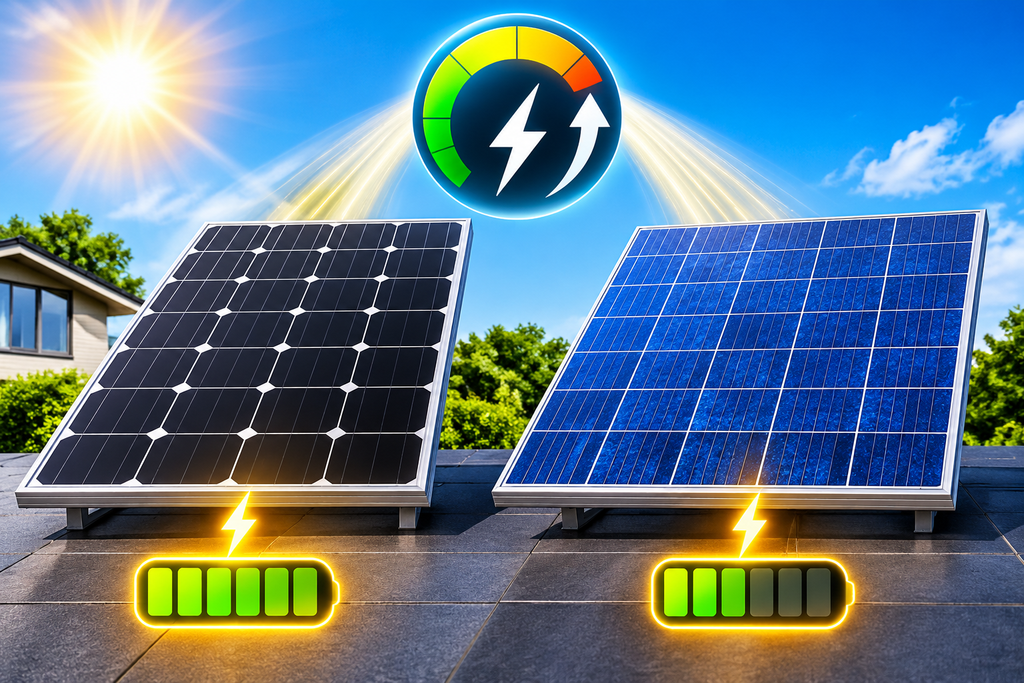
Although both solar technologies use silicon to generate electricity, their construction and performance characteristics are different.
The following comparison explains the main differences.
| Comparison factor | Monocrystalline panels | Polycrystalline panels |
|---|---|---|
| Silicon structure | Single crystal | Multiple crystals |
| Typical appearance | Dark black | Blue or speckled blue |
| Conversion efficiency | Generally higher | Generally lower |
| Power output per square metre | Usually higher | Usually lower |
| Roof space requirements | Generally lower | Generally higher |
| Manufacturing | Single-crystal silicon wafers | Multicrystalline silicon wafers |
| Historical equipment cost | Generally higher | Generally lower |
| Temperature performance | Depends on module specifications | Depends on module specifications |
| Lifespan | Commonly designed for 25+ years | Quality models can also offer long service lives |
| Warranty | Manufacturer dependent | Manufacturer dependent |
| Residential applications | Highly suitable | Suitable where available and appropriate |
| Commercial applications | Highly suitable | Suitable for certain projects |
Important: These are general technology comparisons, not guaranteed specifications for every solar module. Actual performance depends on the manufacturer, cell design, product generation and installation conditions.
1. Solar Panel Efficiency: Which Technology Generates More Electricity?
Efficiency is one of the most important considerations when comparing different types of solar panels.
Solar panel efficiency measures how much sunlight a module can convert into usable electrical energy under specified testing conditions.
For example, a panel with an efficiency rating of 22% converts a greater proportion of the sunlight reaching its surface into electricity than a comparable panel rated at 17%.
Modern commercial monocrystalline modules commonly achieve efficiency ratings around 20%–23%, although some products fall outside this range.
Conventional polycrystalline panels generally have lower efficiency, often around 15%–18%, depending on their age and design.
Why Are Monocrystalline Panels More Efficient?
The main reason is their single-crystal silicon structure.
The more uniform structure allows electrical charges to move through the material with fewer crystal-boundary interruptions. This helps reduce certain energy losses and improves electricity conversion.
Does Higher Efficiency Mean More Savings?
Not automatically.
A higher-efficiency panel can produce more electricity from the same roof area, but the financial benefit depends on several factors:
- Total installation cost.
- Household electricity consumption.
- Roof orientation and inclination.
- Local solar conditions.
- Electricity import and export rates.
- System performance over time.
- Solar battery storage requirements.
For properties with limited roof space, monocrystalline panels can be particularly beneficial.
2. Initial Cost: Which Solar Panels Are More Affordable?
The initial cost of solar panels is another important factor when planning a renewable energy installation.
Historically, polycrystalline modules were cheaper because their manufacturing process required less demanding crystal production. Monocrystalline panels generally carried a higher price because of their manufacturing requirements and efficiency advantages.
However, the solar market has changed considerably.
Manufacturing improvements and large-scale production have made modern monocrystalline modules widely available. As a result, the historical price difference should not be assumed when purchasing a new system.
Factors That Affect Solar Panel Installation Costs
The total cost of a solar PV installation involves much more than the price of the panels.
Important cost factors include:
- Number and capacity of solar panels.
- Panel manufacturer and product specifications.
- Solar inverter type and capacity.
- Roof condition and mounting equipment.
- Electrical installation requirements.
- Labour and installation complexity.
- Scaffolding and access requirements.
- Battery storage, if required.
- Monitoring equipment and additional electrical work.
For an accurate comparison, request quotations based on the complete installed system rather than comparing the price of individual panels.
3. Lifespan and Durability: Which Panels Last Longer?
Solar panels are long-term investments, so their expected lifespan should be considered before making a purchase.
Both monocrystalline and polycrystalline solar panels can provide electricity for many years when manufactured to suitable standards and installed correctly.
Many modern solar modules come with performance warranties of 25 years or more. Some manufacturers also offer separate product warranties covering manufacturing defects and material quality.
However, the warranty period is not necessarily the exact lifespan of a panel.
What Affects Solar Panel Lifespan?
Several factors influence long-term solar panel performance:
- Manufacturing quality.
- Weather exposure.
- Installation standards.
- Roof mounting and ventilation.
- Temperature fluctuations.
- Moisture protection.
- Electrical connection quality.
- Maintenance and inspection.
Panel degradation is also important.
Over time, solar modules gradually lose some of their original power output. Manufacturers normally provide a performance warranty describing the minimum output expected at particular warranty milestones.
Before buying solar panels, check both the product warranty and the long-term performance guarantee.
4. Performance in Different Weather Conditions
Solar panels can generate electricity in different weather conditions, but the amount of electricity produced changes according to available sunlight and operating temperatures.
Performance During Sunny Weather
Both technologies can produce electricity effectively under direct sunlight.
Monocrystalline panels generally have an advantage when installation space is limited because their higher efficiency allows more electricity generation from a similar surface area.
Performance During Cloudy Weather
Solar panels can still generate electricity when the sky is cloudy because sunlight continues to reach the modules through cloud cover.
However, output normally decreases as the intensity of available sunlight falls.
Neither monocrystalline nor polycrystalline panels should be assumed to produce full rated power during overcast conditions.
Performance During Hot Weather
Solar panel temperature is another important factor.
Solar modules are tested under Standard Test Conditions (STC), which include a cell temperature of 25°C. During real-world operation, panel temperatures can rise above this level.
As temperatures increase, electrical output generally decreases.
The temperature coefficient of maximum power indicates how much a panel’s power output changes for each degree Celsius above the reference temperature.
A coefficient closer to zero generally indicates lower power loss as temperature increases.
Instead of assuming one technology always performs better in hot conditions, compare the actual temperature coefficients on the manufacturer’s datasheets.
5. Appearance and Roof Design
The visual appearance of solar panels can influence purchasing decisions, especially for residential properties.
Monocrystalline panels usually have a dark black appearance, which can complement modern roofs and create a consistent finish.
Polycrystalline modules often have a blue or speckled appearance that is more noticeable against darker roofing materials.
Which Solar Panels Look Better?
This depends on personal preference and property design.
Homeowners who prefer a darker and more uniform rooftop appearance may favour monocrystalline panels.
However, appearance should be considered alongside technical specifications, installation requirements and overall system value.
6. Roof Space Requirements
Available roof space is one of the most important factors when selecting a solar PV system.
A property with a large, unobstructed roof may have greater flexibility when choosing different panel technologies.
However, smaller rooftops require careful planning.
Because monocrystalline panels generally have higher efficiency, they can provide more installed capacity within a limited area.
This can be useful for:
- Terraced houses.
- Smaller residential rooftops.
- Properties with roof windows.
- Buildings with chimneys and other obstructions.
- Commercial properties with restricted roof areas.
Polycrystalline panels may require more modules to achieve a similar system capacity, depending on their individual power ratings and dimensions.
7. Maintenance Requirements
Both technologies generally have similar maintenance requirements.
Solar panels do not contain moving parts, so routine maintenance is relatively straightforward compared with many other electricity-generation technologies.
However, regular system checks can help identify issues that may affect electricity generation.
Recommended maintenance considerations include:
- Monitoring solar electricity production.
- Checking for visible panel damage.
- Inspecting mounting equipment.
- Checking inverter performance.
- Reviewing electrical connections through qualified professionals.
- Keeping the modules free from excessive dirt and debris where cleaning is necessary.
The inverter and battery system may have different maintenance or replacement requirements from the solar panels themselves.
Professional inspections should be arranged when performance drops unexpectedly or a system fault appears.
8. Environmental Impact of Both Solar Technologies
Both monocrystalline and polycrystalline panels contribute to renewable electricity generation by converting sunlight into electrical energy without producing direct greenhouse gas emissions during operation.
However, their environmental impact is not limited to their operating stage.
Manufacturing, transportation, installation and end-of-life management also contribute to their overall environmental footprint.
Manufacturing Considerations
Both technologies require silicon processing, manufacturing energy and other materials.
Monocrystalline manufacturing involves producing single-crystal silicon, while polycrystalline production uses multicrystalline silicon.
The overall environmental impact depends on the manufacturing process, electricity sources, material efficiency and supply chain.
Recycling Solar Panels
Solar modules contain materials such as glass, aluminium, silicon and electrical components.
Many of these materials can be recovered through suitable recycling processes.
When a solar installation reaches the end of its useful life, responsible collection and recycling can help reduce waste and recover valuable materials.
Choosing a manufacturer with suitable environmental and product information can help customers make a more informed decision.
Which Solar Panels Are Better for UK Homes?
For most new UK residential installations, modern monocrystalline solar panels are generally the stronger choice.
Their higher efficiency allows homeowners to generate more electricity from limited rooftop space. They are also widely available in modern product ranges, making it easier to compare panel capacity, warranties and technical specifications.
However, the right solution depends on the individual property.
For example, a large property with substantial roof space may have different requirements from a smaller house with several roof obstructions.
When selecting solar panels for a UK home, consider:
1. Roof Orientation
South-facing roofs often provide strong annual solar generation, but east-facing and west-facing installations can also work effectively.
2. Roof Inclination
The angle of the roof affects how much sunlight reaches the panels throughout the year.
3. Shading
Trees, chimneys, neighbouring buildings and other obstructions can reduce system performance.
4. Household Electricity Consumption
Your daily and seasonal electricity usage helps determine the appropriate system capacity.
5. Battery Storage
A compatible solar battery can store surplus daytime electricity for later use, including periods when solar generation is lower.
6. Installation Quality
A correctly designed and installed system is essential for reliable long-term operation.
Are Monocrystalline Panels Better for Commercial Solar Installations?
Monocrystalline technology is also a strong option for commercial and industrial solar projects.
Businesses often have substantial electricity requirements and may want to make effective use of available roof space.
Warehouses, offices, factories, agricultural buildings and commercial premises can benefit from a properly designed solar PV installation.
Benefits for Commercial Properties
- Higher power capacity within limited roof areas.
- Potential reductions in purchased grid electricity.
- Better utilisation of available rooftop space.
- Integration with compatible battery storage.
- Opportunities to manage daytime electricity demand.
- Long-term renewable electricity generation.
For commercial customers, system selection should be based on electricity consumption profiles, roof capacity, project costs, expected generation and the financial objectives of the business.
A professional site assessment can help establish whether rooftop solar is technically suitable.
How to Choose the Right Solar Panels for Your Property
Selecting solar panels involves more than comparing two technologies.
A suitable solar installation should be designed around your property, electricity requirements and long-term objectives.
Here are the main steps to follow.
Step 1: Calculate Your Electricity Requirements
Review your electricity bills to understand your annual consumption.
This information helps determine the approximate solar system capacity required.
Step 2: Assess Available Roof Space
Check the usable roof area, orientation, inclination and potential shading.
A roof assessment helps determine how many panels can be installed safely and effectively.
Step 3: Compare Panel Efficiency and Power Ratings
Look at both the efficiency percentage and rated output in watts.
A higher-wattage panel is not automatically more efficient because physical dimensions also affect its total power rating.
Step 4: Check Manufacturer Warranties
Review product warranties, performance guarantees and the manufacturer’s technical documentation.
Step 5: Consider Battery Storage
If you want to use more of your own solar electricity outside daylight hours, consider whether battery storage is suitable for your property.
Step 6: Compare Complete Installation Quotations
Review the equipment, installation work, warranties, estimated annual generation and total project cost.
Avoid making a decision based solely on the cheapest quotation.
Step 7: Choose a Suitable Solar Installation Company
Work with an experienced solar company that can assess your property, explain equipment options and design a system according to your requirements.
Can You Combine Monocrystalline and Polycrystalline Solar Panels?
Technically, it may be possible to use different types of solar modules within one overall installation, but this requires careful electrical design.
Different panels can have different electrical characteristics, including voltage, current and power ratings.
Connecting incompatible modules in the same string can create performance limitations and electrical design problems.
If different panel types are being considered, a qualified solar designer should assess their specifications and determine whether compatible inverter inputs, separate strings or other suitable arrangements are required.
For most new installations, selecting a consistent set of compatible solar modules is generally a simpler approach.
Why Choose Effective Eco for Solar Panel Solutions?
Choosing suitable solar equipment and arranging a professional installation are important steps towards generating renewable electricity for your property.
At Effective Eco, customers can explore solar energy solutions that take account of their property requirements, electricity consumption and installation objectives.
Whether you are considering solar panels for a home or planning a larger commercial project, selecting appropriate equipment and having the system correctly designed are essential.
Our solar-related solutions include:
- Solar panel supply: Explore suitable solar panel products for residential and commercial requirements.
- Solar panel installation: Arrange professional solar PV system installation for suitable properties.
- Solar battery storage: Consider battery solutions for storing surplus solar electricity.
- Commercial solar systems: Explore solar installations for offices, warehouses, factories and other business premises.
- Solar monitoring: Monitor system performance and electricity generation.
- Renewable energy advice: Understand available equipment and potential system configurations.
Effective Eco aims to make renewable energy solutions easier to understand, helping customers consider the right equipment and installation options for their properties.
If you are planning to purchase solar panels, upgrade an existing system or arrange a new installation, contact Effective Eco to discuss your requirements.
Final Verdict: Monocrystalline vs Polycrystalline Solar Panels – Which Is Better?
When comparing monocrystalline vs polycrystalline solar panels, monocrystalline technology is generally the better option for most new residential and commercial installations.
Its higher conversion efficiency, stronger power density and suitability for limited roof areas make it a popular choice in the modern solar market.
Polycrystalline panels can still be useful in certain situations, especially when comparing older systems or projects where available space and equipment costs are important considerations.
However, the best solar panel is not necessarily the one with the highest efficiency or lowest purchase price.
The right decision should consider the complete system, including panel specifications, roof conditions, inverter compatibility, installation quality, warranties and electricity consumption.
Before investing in solar energy, compare the available equipment and arrange a professional assessment to identify a system that meets your requirements.
Ready to consider solar energy for your property? Contact Effective Eco to discuss solar panel supply, installation and battery storage solutions for your home or business.
Frequently Asked Questions
1. Which is better, monocrystalline or polycrystalline solar panels?
Monocrystalline solar panels are generally better for modern installations because they offer higher conversion efficiency and generate more electricity from limited roof space. Polycrystalline panels can still be considered where suitable products are available and installation space is not restricted.
2. Why are monocrystalline solar panels more efficient?
Monocrystalline panels use silicon wafers made from a single crystal structure. This structure allows electrical charges to move more efficiently through the material, resulting in generally higher electricity conversion efficiency.
3. Are polycrystalline solar panels cheaper than monocrystalline panels?
Polycrystalline panels have historically been less expensive to manufacture. However, modern manufacturing improvements have changed solar panel pricing. The actual cost difference depends on the manufacturer, product specifications, availability and installation requirements.
4. How long do monocrystalline solar panels last?
Many modern monocrystalline solar panels are designed to operate for 25 years or longer. Their actual service life depends on manufacturing quality, installation standards, environmental conditions and maintenance.
5. Do polycrystalline solar panels work on cloudy days?
Yes. Polycrystalline solar panels can generate electricity during cloudy weather because some sunlight still reaches their surfaces. However, electricity production generally decreases when sunlight intensity is reduced.
6. Which solar panels are best for small rooftops?
Monocrystalline solar panels are generally more suitable for small rooftops because their higher efficiency allows more electricity generation from a limited installation area.
7. Do monocrystalline solar panels work better in hot weather?
Monocrystalline panels can offer competitive temperature performance, but the actual result depends on the individual module’s temperature coefficient. Always compare manufacturers’ technical datasheets rather than relying only on the panel category.
8. Can monocrystalline solar panels charge a solar battery?
Yes. Monocrystalline solar panels can be integrated with compatible solar battery storage systems. The solar inverter and battery configuration must be designed to work together correctly.
9. Are monocrystalline solar panels worth the extra cost?
They can be worth the investment when higher efficiency, limited roof space and long-term electricity generation are important. However, customers should compare the total installed cost and estimated electricity generation before making a decision.
10. Which solar panel type is best for UK homes?
Modern monocrystalline solar panels are generally a strong choice for UK homes because of their efficiency, widespread availability and ability to generate substantial electricity from limited roof space. A property’s orientation, shading, roof condition and electricity consumption should also influence the final decision.
11. Can I replace old polycrystalline panels with monocrystalline panels?
Yes, an existing solar installation may be upgraded with modern monocrystalline panels. However, the existing inverter, wiring, mounting equipment and electrical configuration must be assessed before replacement.
12. Do monocrystalline and polycrystalline panels require different maintenance?
Their basic maintenance requirements are similar. Both types benefit from performance monitoring, occasional inspection and professional checks when faults or unexpected production changes occur.